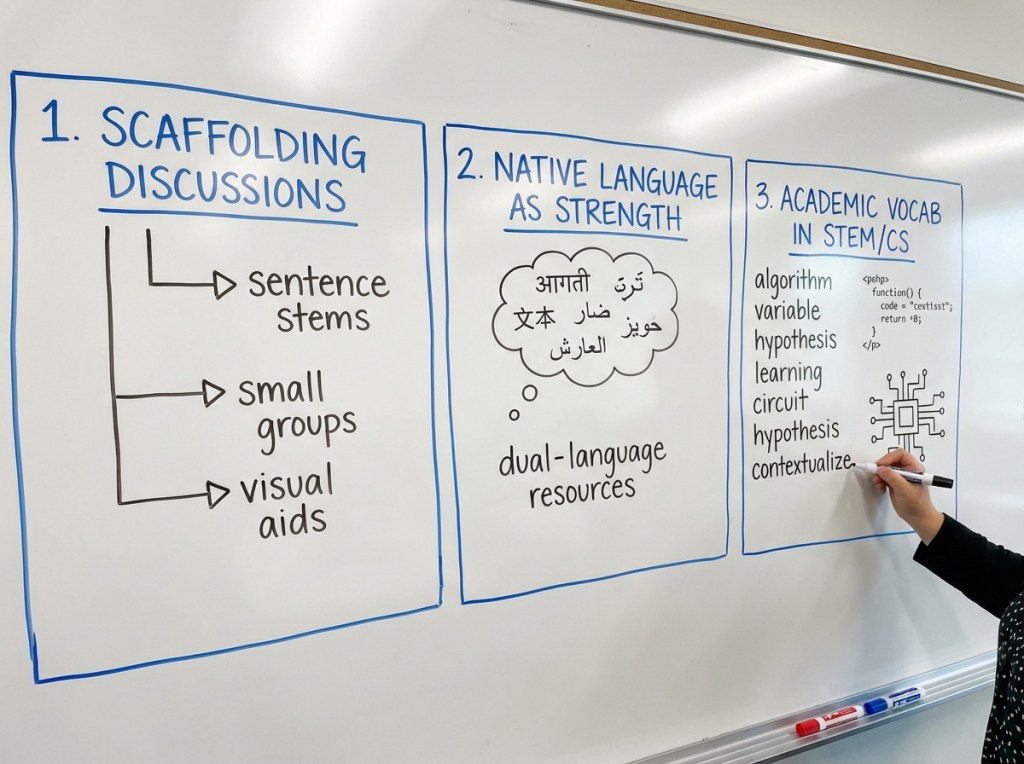
In today’s classrooms, educators are increasingly working with English Language Learners (ELLs) and Multilingual Learners (MLLs). Supporting these students effectively requires more than simply delivering content—it requires intentional strategies that make learning accessible while still maintaining high expectations. Three key approaches that can significantly improve student outcomes are scaffolding classroom discussions, using students’ native languages as a resource, and implementing strong academic vocabulary instruction.
Scaffolding Classroom Discussions
One of the most common challenges for ELL and MLL students is not necessarily understanding content, but actively participating in discussions. Many students possess the knowledge but lack the language skills to express their thinking confidently in English. Scaffolding helps bridge this gap by providing structured support that enables students to engage.
In practice, scaffolding might include providing sentence starters such as “I agree with…” or “I think this means…,” incorporating visuals or diagrams to support understanding, and allowing students time to think or write before speaking. These strategies reduce the pressure of immediate response and give students a clear entry point into discussions.
The impact of scaffolding is significant. Students build confidence, participate more frequently, and gradually improve their language skills through meaningful use. Rather than being placed on the spot, they are given a pathway into academic conversation, which promotes both language development and deeper understanding.
Using Native Language as a Classroom Resource
Another important strategy is recognizing the value of a student’s native language. While traditional approaches often emphasized English-only instruction, current research and classroom experience suggest that a student’s first language can be a powerful learning tool.
Allowing students to think through ideas in their native language, collaborate with peers who share that language, or make connections between languages can deepen comprehension. This approach supports learning by helping students grasp concepts first, then build the English needed to express those ideas.
Importantly, using a native language does not replace English instruction—it strengthens it. It also fosters a sense of respect and belonging, which plays a critical role in student engagement and participation. When students feel that their linguistic background is valued, they are more likely to take risks and contribute in the classroom.
Teaching Academic Vocabulary Effectively
Academic vocabulary presents another major challenge for ELL and MLL students, particularly in content areas such as science, mathematics, and computer science. These subjects often rely on technical and abstract language that can be difficult to understand without explicit instruction.
Effective vocabulary instruction goes beyond memorization. It involves introducing terms using visuals and real-world examples, breaking words down into meaningful parts such as prefixes and roots, and revisiting vocabulary in multiple contexts. Most importantly, students should be given opportunities to actively use new terms in speaking, writing, and problem-solving.
For example, rather than simply defining a concept, students might explain it in their own words, apply it in a task, or connect it to prior knowledge. This approach ensures that vocabulary is not only recognized but truly understood and retained.
Conclusion
Supporting ELL and MLL students ultimately comes down to providing access. Scaffolding discussions, leveraging native language, and teaching vocabulary intentionally are not about lowering expectations—they are about equipping students with the tools they need to succeed.
When these strategies are implemented effectively, students are empowered to participate, engage, and grow academically. In doing so, educators create inclusive classrooms where all learners have the opportunity to reach their full potential.
Citations
Kim, Y. (2010). Scaffolding through questions in the ELL classroom. ERIC.
https://files.eric.ed.gov/fulltext/EJ910116.pdf
Awadelkarim, A. (2021). The effectiveness of scaffolding in language learning. ERIC.
https://files.eric.ed.gov/fulltext/EJ1313714.pdf
Olds, A. (2021). Instructional strategies for English language learners. ERIC.
https://files.eric.ed.gov/fulltext/EJ1308586.pdf
Institute of Education Sciences. (n.d.). Facilitating language and literacy outcomes for English language learners.
https://ies.ed.gov/use-work/awards/bloom-facilitating-language-and-literacy-outcomes-english-language-leaners
Moody, S. (2018). Vocabulary instruction and its impact on reading comprehension. ERIC.
https://files.eric.ed.gov/fulltext/EJ1201080.pdf


Leave a Reply