Communication is at the heart of how we connect, learn, and grow. From expressing ideas to building relationships, strong communication skills are essential in both school and everyday life. However, for some individuals—especially children—communication can be challenging. This is where speech-language disorders come into focus.
What Is a Speech-Language Disorder?
A speech-language disorder refers to difficulties in understanding and/or using spoken language, written language, or other forms of communication. These challenges can affect how a person:
- Produces sounds (speech)
- Understands language
- Expresses thoughts and ideas
- Communicates in social settings
According to the American Speech-Language-Hearing Association, speech-language disorders include problems with communication as well as related areas such as oral motor function. These difficulties can vary in severity and may impact both academic performance and social interactions.
The Three Main Areas of Impact
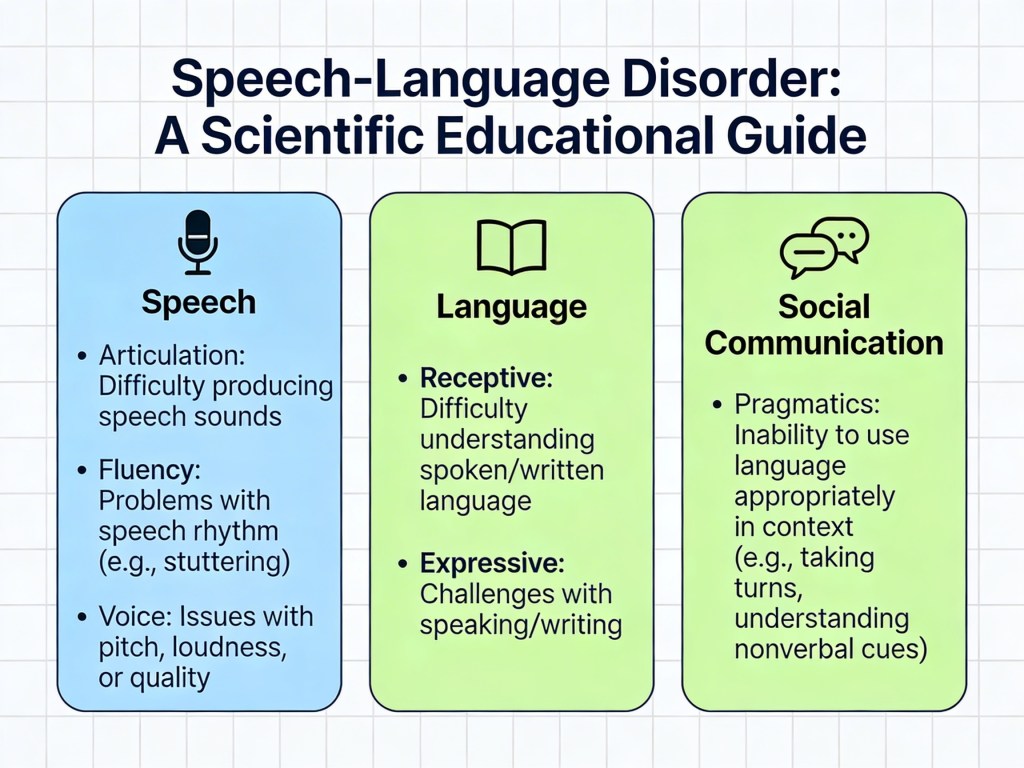
Speech-language disorders typically fall into three key areas:
1. Speech
Speech refers to the physical production of sounds. Challenges in this area may include:
- Difficulty pronouncing words clearly (articulation)
- Stuttering or interruptions in speech flow (fluency)
- Issues with voice quality, pitch, or volume
2. Language
Language involves both understanding and expressing ideas.
- Receptive language: the ability to understand spoken or written language
- Expressive language: the ability to communicate thoughts through speaking or writing
Children with language difficulties may struggle to follow directions, answer questions, or organize their thoughts clearly.
3. Social Communication (Pragmatics)
This area focuses on how language is used in social situations. Challenges may include:
- Difficulty taking turns in conversation
- Trouble understanding tone, humor, or body language
- Struggles with appropriate responses in different settings
Speech-Language Disorders in Education
In the classroom, speech-language disorders can directly affect a student’s ability to learn, participate, and engage with others. Under the Individuals with Disabilities Education Act, a speech or language impairment is defined as:
“A communication disorder… that adversely affects a child’s educational performance.”
This means schools have a responsibility to identify and support students who need help in these areas.
Why Early Support Is Important
Early identification can make a significant difference. When speech-language challenges are recognized early, children can receive targeted support that helps them:
- Build confidence in communication
- Improve academic performance
- Develop stronger social connections
The National Institute on Deafness and Other Communication Disorders highlights the importance of monitoring communication milestones to ensure children are developing appropriately and receiving help when needed.
How to Support Children with Speech-Language Disorders
Supporting a child with communication challenges doesn’t require perfection—it requires consistency, patience, and awareness. Some effective strategies include:
- Encouraging open conversation in a low-pressure environment
- Modeling clear and simple language
- Giving children time to respond and express themselves
- Collaborating with teachers and speech-language professionals
- Using visuals, gestures, and other supports to aid understanding
With the right support system, children can make meaningful progress and develop strong communication skills over time.
Final Thoughts
Speech-language disorders can impact how individuals communicate, learn, and interact with the world—but they do not define a person’s potential. With early intervention, supportive environments, and intentional teaching, individuals with speech-language challenges can thrive both academically and socially.
References
- American Speech-Language-Hearing Association. (n.d.). Speech and language disorders.
- Individuals with Disabilities Education Act. (2004). Sec. 300.8 Child with a disability.
- National Institute on Deafness and Other Communication Disorders. (2016). Speech and language developmental milestones.
- American Speech-Language-Hearing Association. (n.d.). Speech and language disorders. Retrieved from https://www.asha.org/public/speech/disorders/
- Individuals with Disabilities Education Act. (2004). Sec. 300.8 Child with a disability. U.S. Department of Education. https://sites.ed.gov/idea/
- National Institute on Deafness and Other Communication Disorders. (2016). Speech and language developmental milestones. U.S. Department of Health and Human Services. https://www.nidcd.nih.gov/
 Devan Gillaird
Leave a comment